I've not posted a blog here in literal years... which I always kind of assumed would happen when I added a blog to the site. I'm sure I've worked on reasonably interesting things somewhere along the way but it is what it is. Anyway, here's something interesting enough and it might even have some useful information for someone who finds themselves with an Unexpected Pachinko Machine in their life, so let's commit it to the internet.
I feel like a lot of kids, at least around my age, probably had little trinket Pachinko toys when they were younger; of course, pre-internet, I had no idea that’s what they were called as a kid but I definitely remember having a few small hand-held toys that more or less met the criteria. I actually remember my daughter having a little Mario-themed one that she got maybe in a Happy Meal or at a birthday party or something just a few years ago when she was little - though it’s just as likely that I’m imagining it.
Anyway, I always thought the mechanics of the things were cool, and remained so once I found out about the real thing somewhere along the way, and I always thought it would be neat to have one (but not neat enough to actually go out and find one, I suppose). But now that we’re in 2026 and I have a little time and just enough disposable income, I stumbled across one at an estate sale and pretty quickly talked my way into buying it, with my daughter’s prodding, and bringing it home.
The Game
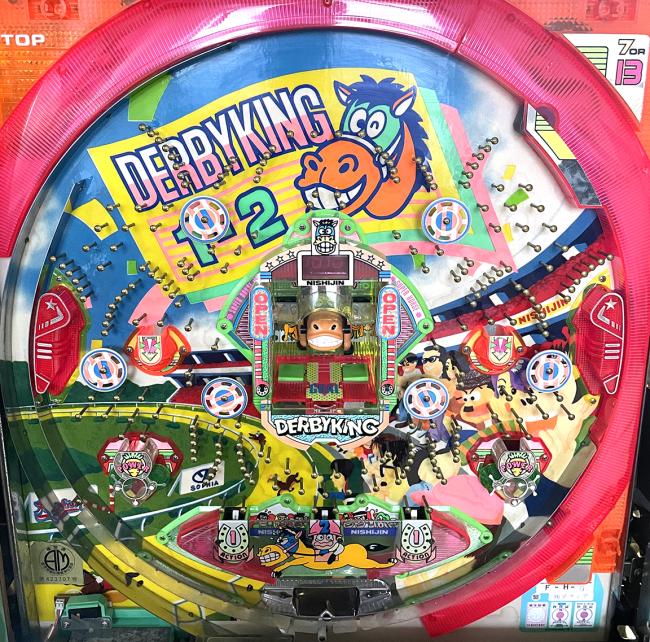
I’m no Pachinko historian, so I’ll leave that to those who might be, but in short, Pachinko is a game that straddles chance and skill, firing steel balls into a vertical playfield full of targets and metal pins. The pins catch and bounce the balls around as gravity pulls them down to scoring targets, or, more likely, into the waste chute that takes the balls away from the player. In a traditional Japanese Pachinko hall, the player will buy a bin of balls at the start and take it to their preferred machine; winning shots pay out in additional balls while losing shots fall behind to be collected in employee-only areas, to be reloaded into the machine or returned to the front to be purchased again by other players.
My New Machine
I’m still struggling to find out much about the machine, the Derby King, even a couple months after first buying it. Nishijin, the manufacturer, was founded in 1951, but machines featuring animatronics and rudimentary LEDs like the Derby King came in much later, in a wave of Pachinko machines called Hanemono. From the best I can tell, Hanemono machines started production in the early 1980s and ran for about a decade and a half before more modern, more computerized machines took over. Based on the art style and theme of this machine, I think it’s likely to be from the early 90’s, in one of the later waves of Hanemono, but the only Japanese art I ever actively studied was pre-modern, so I’m game to be corrected.
In Hanemono machines, wins can build upon themselves. Most winning rounds start with a shot to one of the pockets at the bottom of the game board, which does a payout and opens the attraction in the middle. In Derby King, this opens two tulips which will allow balls to reach the attraction. At this point, to hit the jackpot, the player has to get a ball into the central goal, and then another ball into the tulips that will trigger a kicker under the central goal to fire that ball into the horse’s mouth. It’s delightful when it happens but I can’t imagine many players ever got to encounter it - it’s hard enough to do with the machine disassembled and applying the balls by hand, because there's a limited time to get all the balls into the right spots.
This machine has a bell that rings with payouts, as well as a small speaker to play synthesized sounds and music during wins. It also has about a dozen and a half lights and the LED number board and blinkers in the attraction; more to say on the lights in a bit, in the second half of the blog.
- Log in to post comments